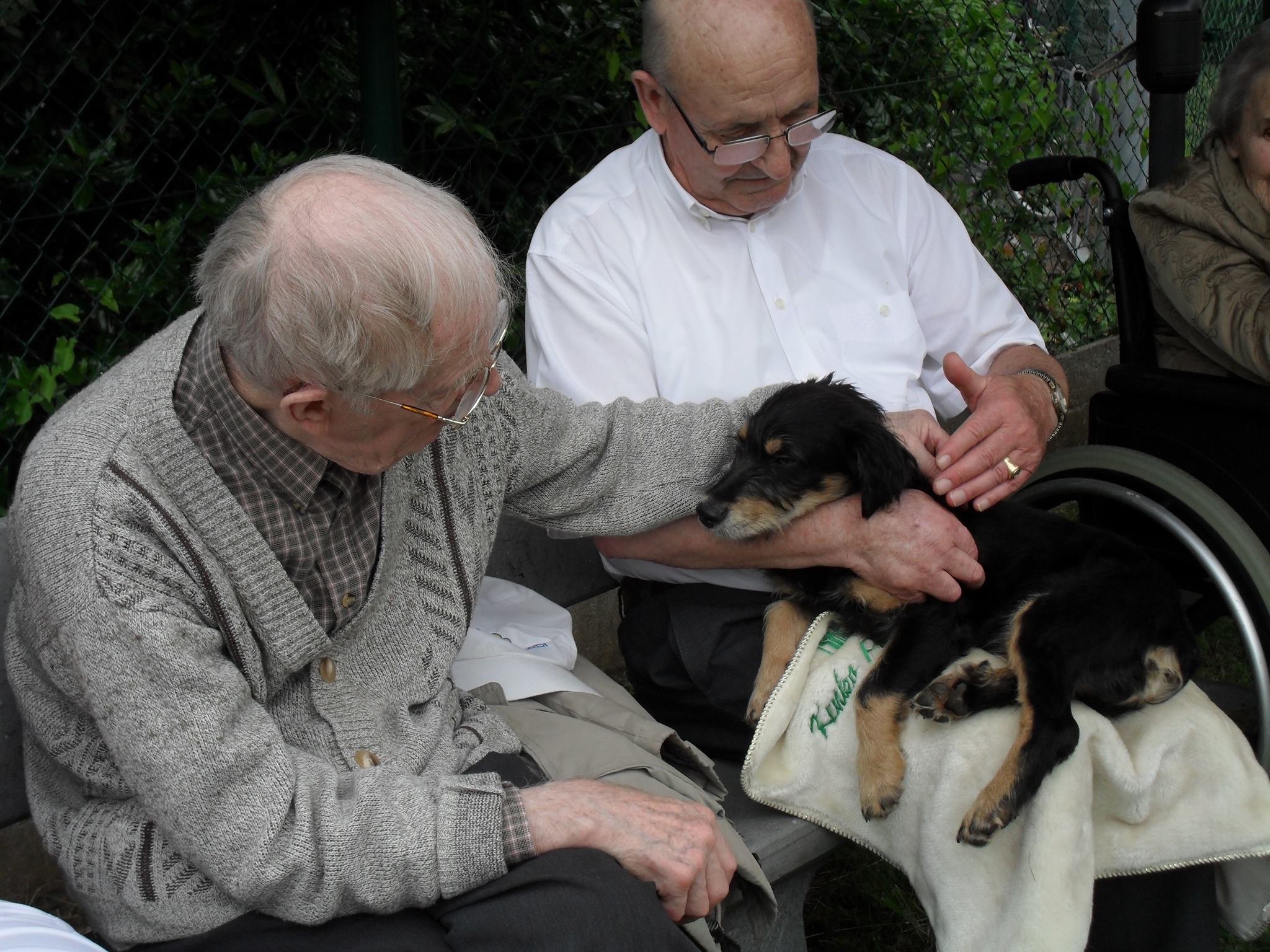
Dog in nursing home or other institution: Excerpts from Interview with Inge from Therapy Animal by Ilona Ruelens (March 24, 2022)

Dog in residential care center. Cuddle dog in schools. Therapy dogs in hospitals, in the office, in prisons... you hear about it more and more.
Inge Pauwels is Managing Director of Toscanzahoeve (animal behavior and welfare – training sessions + dog behavior tests) & chairperson of Therapiedier vzw (everything involving therapy animals – training of classroom dogs and those active in residential care centers).
There are benefits, but also dangers to having a dog in a residential care center.
Nowadays therapy animals are very trendy, and we also see people getting to work with an uncertified animal, and incidents happening where the insurance pulls out. Often also people who are not trained for it.
When a dog is purchased by a residential care center, they also often do not know what to look for, and end up with a puppy mill or hyperkinetic dog, a dog that does not listen or has medical issues, etc.
There is not really a suitable breed; it depends more on temperament and upbringing. Breeds such as Keeshonds, Huskies, and Shiba Inus (primitive types) are less suitable because they are less affectionate, but exceptions always exist. Hunting dogs are also less suitable because they need a lot of exercise, which can already be a challenge in itself for a family.
What we personally work with are American Staffords. These are quickly labeled as dangerous, but they are super good therapy animals provided they pass a behavior assessment (eager to learn, manageable, predictable, human-oriented) and upbringing.
Adaptability and the importance of body language.
Dogs are the most domesticated animals, and will indeed adapt to the environment and what is asked of them. For example, you can put a dog that is normally hyperactive with a child in a wheelchair, and it suddenly becomes calm.
As long as people take an animal's stress and body language into account, there is no problem with alternating between the office and the home environment, or a residential care center. If the dog shows signs of stress, you must relieve the dog by letting it stay home for a day or only taking it along for a few hours. That depends on how sensitive the dog is. That is also the most important thing to teach people.
We often see people who have been dog owners for years but actually do not know much about body language. This even occurs among groomers, pet store employees, shelter workers, police...
This can be learned with a few additional training courses.
Not just any dog and any owner...
We do not certify the dog if the owner has not had additional training. Insurance companies also pay very close attention to this. Insurers consider it ‘normal for accidents to happen if you cannot read the dog.’ A dog bites for a reason.
It is important that every dog can retreat to a safe resting place. If a puppy or adult dog is constantly being engaged, it will become overstimulated. The theory that a dog may only have 1 master was already refuted in 2009 and 2013.
Anyone who comes into contact with the dog must be able to understand it. If one caregiver is unavailable, someone else must be able to walk or care for it. Especially with a dog in a residential care center or other institution, it is also important that the entire team supports it.
In practice …
With a class dog, the teacher will teach the children how to handle a dog responsibly by walking and caring for it together. It is also important that everyone gives the dog the same commands and instructions. Otherwise, the dog will get confused. If that is not possible, a few should be responsible.
It is not a problem for a dog to be cared for by an employee when the owner is on vacation, that is similar to a dog staying in a boarding kennel. Just make sure that the same commands are given and the owner's rules are taken into account.
During exercises with an occupational therapist in a residential care facility, we usually keep the dogs on a leash because otherwise they get distracted. But an office dog needs room to move. Tying up a dog is ethically unjustified and loses its purpose in that kind of environment.
Before bringing multiple dogs into contact, you must build this up by letting them get acquainted and always keeping an eye on them.
Usually, a temporary presence of the animal is better than a permanent one. One dog can cope with it better than another. If you see that the dog is becoming more nervous and falls asleep like a log at home, you know that it is better to give it some rest the next day to recover.
Dog in nursing home: the importance of proper training.
I believe in a positive, permissive upbringing, but this cannot work without agreements and rules. It is a big risk, and sooner or later something happens. You see this, for example, in the off-leash dog area. Many people let their dogs off the leash there, but you never know in advance which dogs your dog will get along with. Residential care centers are more familiar with rules. Things usually do not go too badly there.
I think it would be an added value if animal friendliness were mentioned in the residential care inspection reports, so that it also becomes more well-known to the government. Right now, politicians are not concerned with it and do not think about it. I myself would also rather live in a residential care center where animals visit and where this is well organized. It must be terrible to have to leave your pet behind.
I work for many shelters, but we have also seen at the dog schools that a lot more people have started following this, so it is not that black and white. There are also people who did not buy puppies impulsively during Covid-19. Getting a dog from the shelter is of course even better.
Animals can alleviate all forms of loneliness. During Covid-19, for example, there was a great lack of hugs. I wouldn't dare to say whether it works in the long or short term, because there hasn't been enough research on it. Studies have been conducted in America, however, which show that the number of pills and medical costs decrease in the presence of therapy animals. So, in my opinion, the costs for the animals are balanced out by that.
Be sure to check out our section ‘for your organization‘to see what we can do for you.


