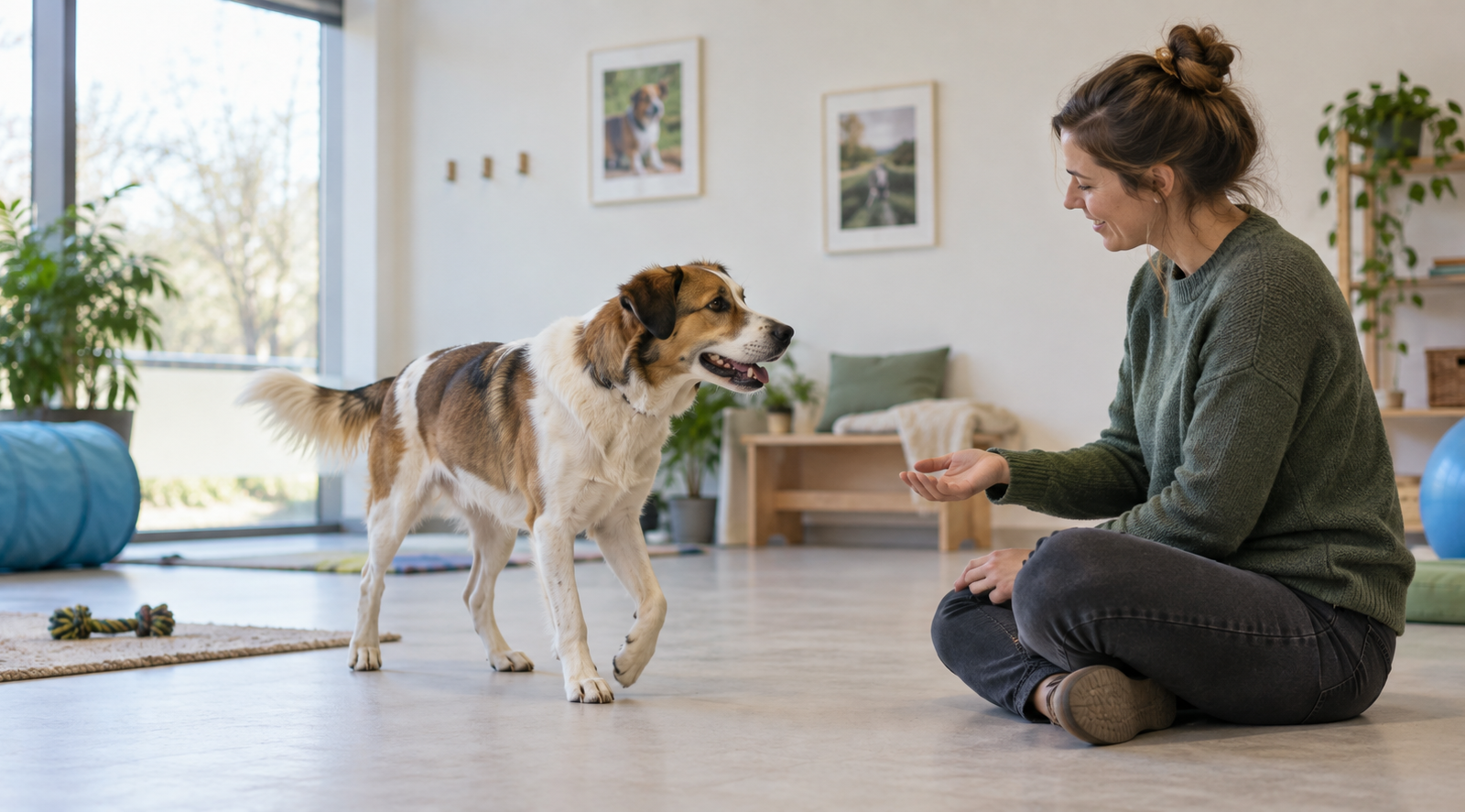
Anyone who delves into therapy animals, assistance-oriented support, or Animal Assisted Interventions (AAI) will encounter various behavioral tests. Two names that regularly come up are the MAG test and the PADA test. But what exactly is the difference? And why does Therapiedier vzw work with an extensive MAG test?
MAG stands for Socially Acceptable Behavior. The original MAG test was developed to assess a dog's behavior in various situations in a standardized way. How does a dog react to people? What happens when it is confronted with unexpected stimuli? How does it handle tension? Do we see insecurity, avoidance, or aggressive behavior? These are important questions. Especially when a dog will later come into contact with children, the elderly, people with disabilities, or other vulnerable target groups, safety must be an essential prerequisite.
However, for Therapiedier vzw, safety alone is not enough. A dog can exhibit perfectly socially acceptable behavior and still not be happy with the work expected of a therapy animal. That is why we have expanded the MAG test within our operations. We want to know not only what a dog does in a given situation, but also try to understand who that dog is and how it experiences that situation.
During our comprehensive MAG assessment, in addition to socially acceptable and safe behavior, we therefore also look at personality, social behavior, initiation of contact, self-confidence, curiosity, sensitivity to stimuli, body language, frustration tolerance, individual preferences, and stress tolerance. Stress and recovery are also particularly important to us. A reaction to an unexpected stimulus tells us something, but at least as interesting is what happens afterward. Can the dog release the tension quickly and function relaxed again, or does the tension remain present? How clearly does it communicate that something is becoming difficult? This creates a much broader picture of the individual dog.
PADA stands for Personality Assessment of Domestic Animals. As the name suggests, this assessment places a strong emphasis on mapping personality and behavior patterns. By observing an animal in various standardized situations, traits such as social behavior, curiosity, self-assurance, and reactions to new or unexpected stimuli can be revealed. The goal is not simply to judge a dog as ‘good’ or ‘bad,’ but to obtain a profile of the individual animal.
That immediately highlights a major similarity with our comprehensive MAG assessment. Dismissing the difference between the two proposals as “MAG looks at safety and PADA looks at personality” is too simplistic for our way of working. After all, our comprehensive MAG assessment includes both elements. We naturally want to know whether a dog can function safely and in a socially responsible manner, but at the same time we want to understand its personality, stress processing, resilience, social preferences, and stress tolerance. For us, the difference therefore lies primarily in the framework in which we use that information. Within Therapiedier vzw we link our observations directly to animal welfare and future deployment within AAI.
At the same time, we find it important to not just ask whether a dog is suitable as a therapy animal. That question is actually too general. After all, there is no single fixed type of dog that is a therapy dog. One dog might enjoy calm, individual contact with an elderly person in a residential care center, while another dog feels comfortable with children and a bit more activity. A dog that functions excellently during one-on-one contacts might find a busy classroom overwhelming. And a dog that spontaneously seeks contact with people does not necessarily like to be touched for a long time by various unknown individuals.
Therefore, we prefer to ask the question: what form of engagement suits this individual dog, his personality, his capabilities, and his limits? Sometimes this may also show that professional deployment as therapy animal is not the best choice. That does not mean there is anything wrong with that dog. On the contrary, by recognizing this in a timely manner, we can prevent an animal from ending up in a role that inadequately aligns with its needs.
Being able to and wanting to are two different things, after all. A dog can learn to stay quietly somewhere while people touch him. He can learn to enter a busy room and he can learn all kinds of tasks and exercises. But the fact that a dog has learned something and performs it does not automatically mean that he feels good doing it. That is why we look not only at what a dog can do, but also at what he tells us through his behavior and body language about what he can handle and what he finds pleasant.
For us, a therapy animal is not an instrument used to serve humans, but an active partner within the cooperation between humans and animals. Animal welfare therefore means more than preventing aggression, fear, or physical discomfort. It also means taking preferences, freedom of choice, recovery, workload, and the ability to set boundaries into account.
Even an extensive MAG test remains, of course, a snapshot in time. A good assessment does not mean we never have to look at the dog's behavior and welfare again afterward. Age, health, experiences, environment, and stress levels can change. A dog that happily performs a certain activity today does not necessarily have to feel the same way about it for the rest of its life. That is why, for us, a behavioral test belongs within a broader trajectory of training, observation, guidance, and continuous attention to animal welfare.
Therefore, we do not view the MAG test and PADA test as two systems that should be opposed to one another or where one is by definition better than the other. There are clear overlaps. PADA is aimed at making personality and behavioral characteristics visible. Within Therapiedier vzw, we have expanded our MAG assessment so that in addition to socially acceptable and safe behavior, we also examine personality, stress management, recovery, resilience, and well-being, and interpret this information specifically in terms of potential deployment within Animal Assisted Interventions.
Ultimately, it comes down to one principle for us: we do not want to try to make every dog fit a certain task. We want to look for a task, target audience, and environment that suit the individual dog.
Therefore, at Therapiedier vzw we don't just ask: “Can this dog do this?”
We mainly ask: “Does this task, target audience, and environment suit this dog, and can it function safely and with its well-being maintained?”
For us, that is the basis for working responsibly with therapy animals.


