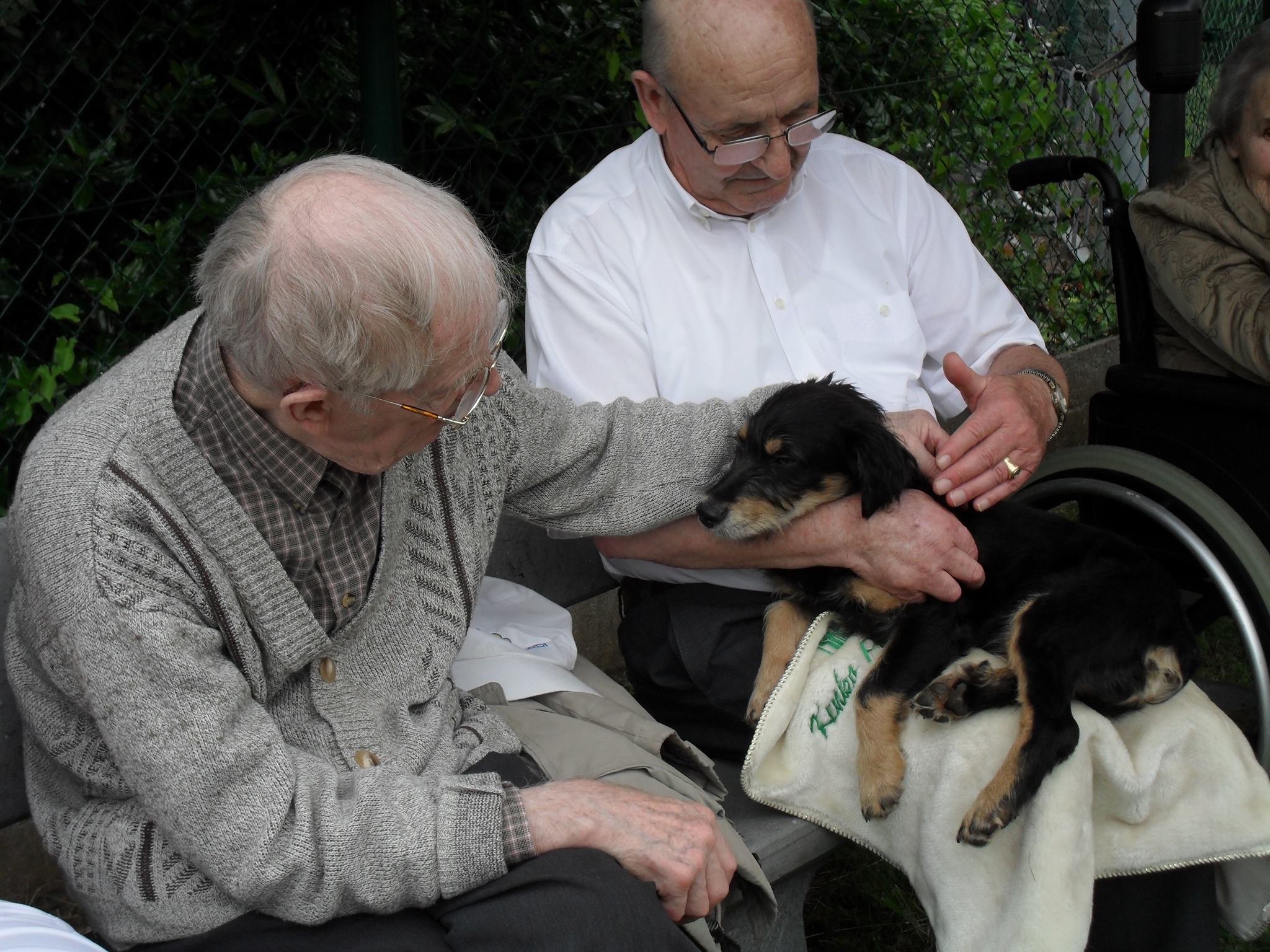
The words therapy dog, support dog, assistance dog, and assistance dog are often used interchangeably. Yet, dogs can fulfill very different roles. The main difference lies not in the harness or the designation, but in three questions: for whom does the dog work, in what environment is it deployed, and what concrete skills or tasks has it learned?
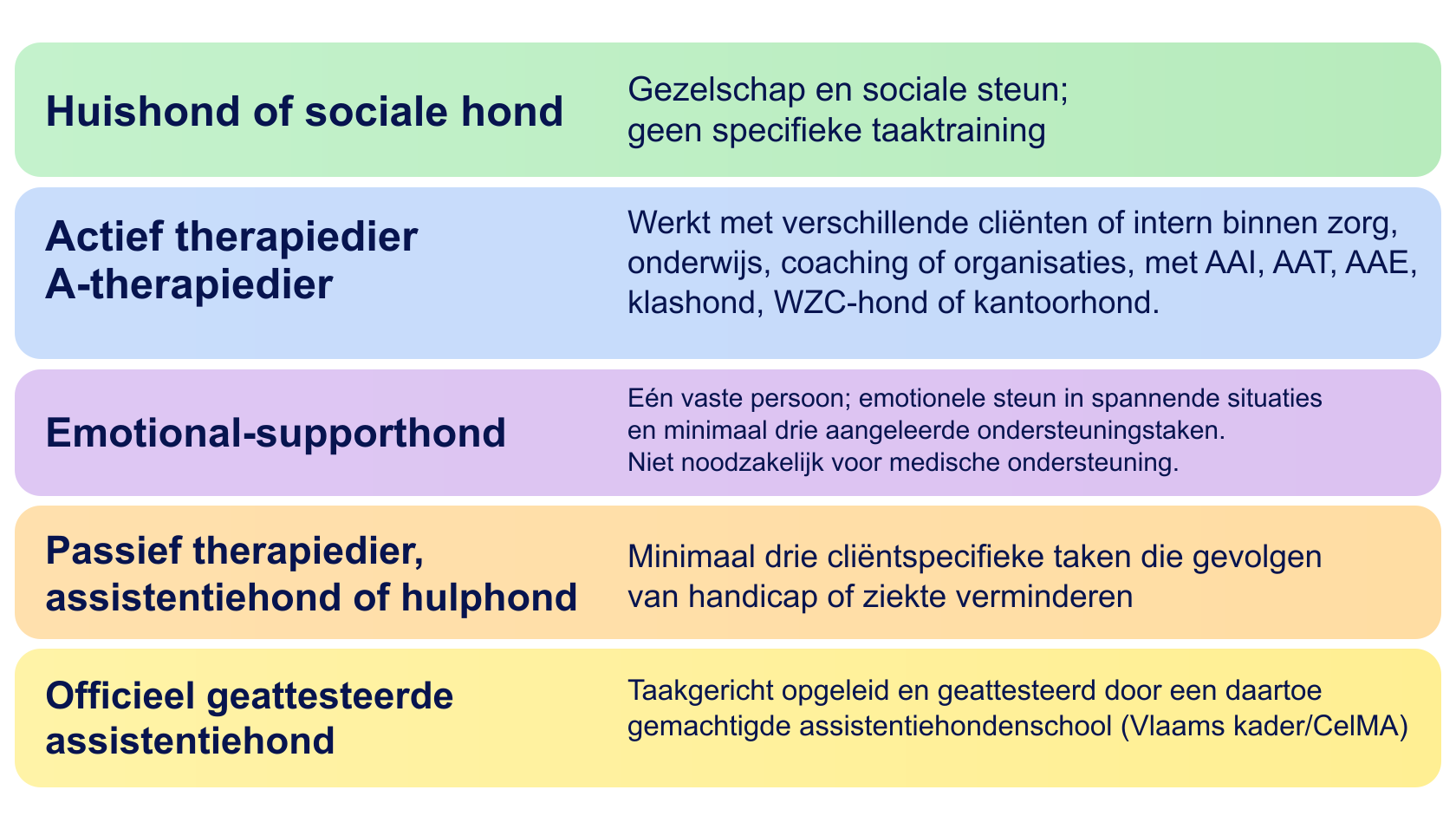
Our color scheme helps to make those differences more visible.
The house dog or social dog
A pet dog or a social dog is first and foremost a companion animal. It offers closeness, fun, social contact, and emotional support by simply being there.
That can be particularly valuable. A social dog does not have a specifically defined work role and does not need to undergo task-oriented training.
A social dog is therefore not inferior. He just has a different role.
The active therapy animal or A-therapy animal
An active therapy animal works together with a practitioner for different clients. The animal may also be based within a school, residential care home, healthcare practice, organisation or workplace.
The supervisor remains responsible for the purpose of the intervention, the client's supervision, the safety of all involved, and the monitoring of the boundaries and the well-being of the animal.
An A-therapy animal can be involved in various forms of animal-assisted work:
- AAI: Animal-Assisted Interventions of animal-assisted interventions;
- AAT: Animal-Assisted Therapy or animal-assisted therapy;
- AAE: Animal-Assisted Education;
- activities and guidance in healthcare and welfare;
- The role as a guard dog, a care-home dog or an office dog.
Not every dog that is regularly present in a classroom, workplace or care setting is automatically a therapy animal. Proper preparation, professional guidance, clear objectives, safety and animal welfare are essential.
The emotional support dog
An emotional support dog provides one constant person with emotional support, closeness, and reassurance in daily life. The dog can support in various exciting, stressful, or unpredictable situations.
Within the Therapiedier vzw programme, the dog learns at least three individually trained support tasks. Examples include making targeted contact when tension rises, helping interrupt a pattern, offering closeness in response to a learned cue, supporting rest and recovery, or guiding the person to a quiet place.
There is not necessarily a need for medical support. An emotional support dog is not the same within our operations as an officially certified assistance dog, and the designation does not automatically grant access.
The individual support animal, assistance dog or service dog
An individual support animal also assists one specific person. Unlike an active therapy animal, this dog does not work with different clients.
In our approach, the role of an individual support animal is closely related to that of an assistance or service dog. The dog learns at least three client-specific tasks that help reduce the functional impact of an illness, disability or other limitation.
Depending on the support request, this can include:
- alert and signal support;
- autism-oriented support;
- psychosocial support;
- motor and practical support;
- stimulus regulation;
- safety and orientation;
- the interruption of disruption or overload;
- guiding them to a quiet or safe place;
- picking up, bringing or handling objects.
The tasks are tailored to the person, the living environment, and the capabilities of the dog. They must be concrete, observable, and reliably executable. The well-being of the dog remains crucial as well. Not every dog is suited for this role, and not every support request can be satisfactorily fulfilled by a dog.
The officially certified assistance dog
The yellow category in the scheme refers to an assistance dog that is task-orientedly trained and officially certified through an assistance dog school authorized by CelMA.
That official certification must be distinguished from an internal training dossier, certificate or functional statement from another training organization. In Flanders, the legal access right and any VAPH–concession linked to the official certification are linked. Read more at the VAPH.
No rank order, but different functions
The scheme is not intended as a ladder whereby every dog must eventually become an assistance dog. Each category has its own function.
A companion dog can have a major positive impact without performing trained tasks. An active therapy animal can work professionally with different clients without being an assistance dog. An individual support animal or assistance dog, by contrast, focuses on supporting one specific person.
The right question is therefore not only which title a dog gets, but especially:
- Which person or persons support the dog?
- What concrete tasks does he carry out?
- In which environment does he work?
- Who bears the professional responsibility?
- Is the investment safe, feasible, and focused on well-being?
- What training, follow-up or official certification is required?
A tailor-made program for humans and animals
A suitable program always begins with a careful intake and an honest assessment of the human-animal combination. Then goals, tasks, training steps, and evaluation moments can be established.
At Therapiedier vzw, the desired outcomes for the person are not the only priority. The animal’s resilience, motivation, health, rest and freedom of choice also determine what is responsible and feasible.
Want to know which course is right for you and your dog? Then contact us for a consultation.


 MAG test or PADA test: what is the difference?